
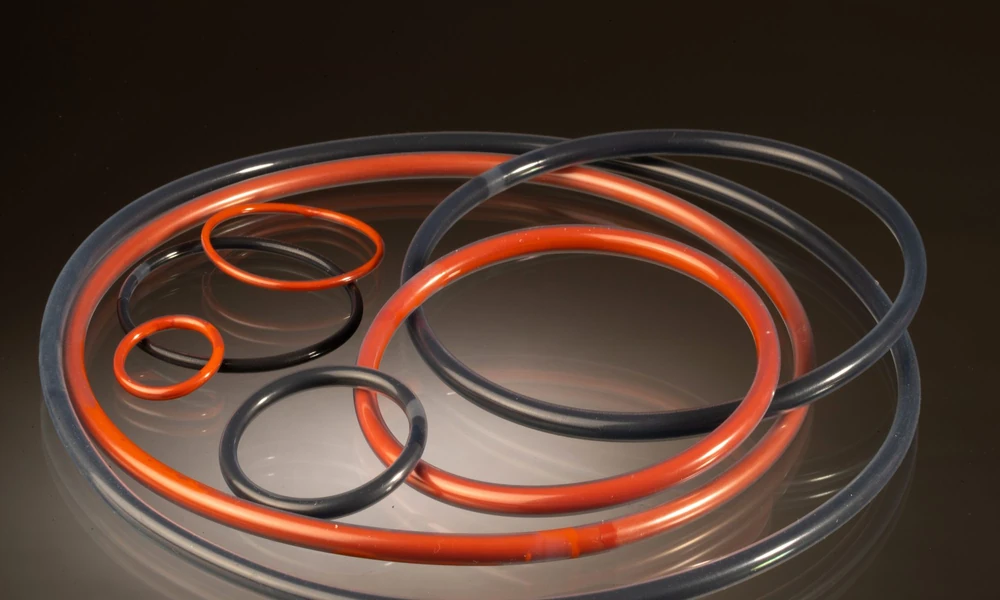

Encapsulated O-rings address a specific gap in sealing technology that becomes apparent when the process chemistry, temperature, or pressure environment of an application exceeds the capability of standard elastomeric O-rings. A standard Viton, EPDM, or nitrile O-ring provides excellent sealing performance within its chemical and thermal limits, but when those limits are exceeded, seal degradation leads to leakage, contamination, and the safety and process integrity consequences that follow. The PTFE encapsulated Viton O-ring combines the universal chemical resistance of PTFE with the elastomeric resilience that provides sealing force, offering a solution for applications where neither material alone is adequate.
How Encapsulated O-Rings Are Constructed
A PTFE encapsulated O-ring is manufactured by encasing an elastomeric core, typically Viton (FKM) or silicone, within a thin PTFE jacket. The PTFE jacket provides the chemical contact surface, giving the O-ring PTFE’s near-universal chemical resistance in the media-contacting zone. The elastomeric core provides the spring-back force that maintains sealing contact across the range of compression and temperature variation that the installation encounters.
A related construction uses FEP (fluorinated ethylene propylene) as the encapsulating material rather than PTFE, offering the same chemical resistance profile with better conformability due to FEP’s lower melt viscosity, making FEP encapsulated O-rings preferable in applications where the sealing groove geometry is non-standard or where a tighter fit is required.
Advantages of Encapsulated O-Rings
Encapsulated O-rings offer several performance benefits compared to conventional elastomeric seals.
Some of the primary advantages include:
- Outstanding chemical resistance against aggressive media
- Excellent resistance to oxidation and corrosion
- Wide operating temperature range
- Reduced product contamination
- Low friction characteristics
- Long service life
- Minimal maintenance requirements
- Compatibility with demanding industrial environments
Because the fluoropolymer outer layer isolates the elastomeric core from the process media, the seal remains protected even in applications involving highly corrosive fluids that would rapidly degrade traditional rubber O-rings.
When to Specify Encapsulated O-Rings
High heat O-rings in encapsulated construction are specified when one or more of the following conditions apply:
- The process fluid is too aggressive for standard elastomers including Viton: concentrated acids, strong alkalis, ketones, esters, and highly oxidising media that attack FKM can all be handled by PTFE-encapsulated seals
- The application involves steam or high-temperature water where EPDM is often preferred but PTFE encapsulation provides better resistance to high-pressure steam
- Pharmaceutical or food contact applications where extractable content from the elastomeric O-ring must be minimised to meet regulatory requirements
- Semiconductor processing environments with highly pure media where any elastomer contamination of the process fluid is unacceptable
- Mixed-media systems where a single seal must handle alternating exposure to multiple incompatible process fluids
Temperature Considerations for High-Temperature Applications
High temperature O-rings in encapsulated construction have their operating temperature range determined by both the encapsulation material and the core elastomer. FEP and PTFE-encapsulated O-rings with Viton cores are typically rated to continuous operating temperatures of 200 degrees Celsius and above, with peak temperature capability up to 250 degrees Celsius for short durations.
It is important to note that at high temperatures, PTFE’s lower stiffness means that encapsulated O-rings may extrude into gap clearances more readily than standard elastomeric O-rings. Groove design for high heat O-rings must account for this characteristic, and anti-extrusion backup rings may be required in high-pressure applications at elevated temperature.
Groove Design and Installation Considerations
O-rings and seals in encapsulated construction require careful attention to groove design because the PTFE or FEP jacket is significantly less conformable than a bare elastomeric O-ring. The groove dimensions must accommodate the slightly different compression behaviour of encapsulated seals relative to standard elastomeric equivalents. Most encapsulated O-ring manufacturers provide groove design guidance specific to their product range, and using these design guidelines is important for achieving the sealing performance the component is intended to provide.
Common Industrial Applications
Because of their versatility, encapsulated O-rings are widely used across numerous industries where aggressive process conditions exist.
Typical applications include:
Their ability to withstand harsh chemicals while maintaining reliable sealing performance makes them an ideal choice for critical industrial processes.
Conclusion
Encapsulated O-rings bridge the gap between standard elastomeric seals and solid PTFE seals, offering the chemical resistance of fluoropolymer materials with the sealing force and resilience that only an elastomeric core can provide. Specifying the correct encapsulation material, core elastomer, and groove geometry for the specific application conditions produces a seal that performs reliably in environments where standard O-rings and seals would fail prematurely.

Leave a Comment